
The project addresses the growing threat posed by hostile cognitive operations as a means to destabilize democratic states. The foundational premise of the project is that cognitive warfare, defined by NATO as the influence of cognitive processes to gain strategic advantage, represents a significant challenge to international security, especially for democratic states. The research examines the compatibility of cognitive operations with democratic principles and international law, effective protective measures for democratic states, and the consequences of adopting a more offensive approach. The primary objective of the project is to conceptualize and operationalize the idea of cognitive warfare and evaluate the adequacy of existing legal regulations.
The project addresses key questions regarding the alignment of cognitive operations with democratic principles, effective methods for protecting democratic states, legal norms prohibiting cognitive warfare, and the conditions under which offensive actions against authoritarian regimes may be permissible. The research findings will contribute to a better understanding of cognitive manipulation mechanisms and the development of defensive strategies for democratic states.
- The project includes the following research tasks:
- Conceptualization of “cognitive warfare.
- NATO’s approach to cognitive warfare.
- China’s cognitive warfare in the context of great power rivalry.
- The assessment of cognitive warfare under jus ad bellum.
- Cognitive warfare as a challenge for international humanitarian law.
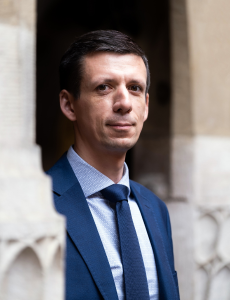 Łukasz Kamieński is a professor of social sciences in security studies at the Institute of American Studies and Polish Diaspora, where he serves as the head of the Chair of American Studies. He also leads the LSE IDEAS Central and South-Eastern Europe Program at the Jagiellonian University at the Faculty of International and Political Studies. He is the deputy chair of the Discipline Council for Security Sciences at the Jagiellonian University (term: 2022-2025). From 2020 to 2024, he served as the director of the Institute of American Studies and Polish Diaspora at the Jagiellonian University, and from 2016 to 2020, he was its deputy director for general affairs. His main research interests include the strategic aspects of international relations, the future of warfare, the impact of new and emerging technologies on the conduct of war, the use of biotechnology (particularly neurotechnology) for military enhancement, non-kinetic offensive actions, and the ethical and social aspects of the development of new technologies and their military applications. He has completed numerous international research fellowships, including at the University of Pennsylvania in Philadelphia (2024, 2023), LSE IDEAS in London (2019, 2011), Department of International Relations, LSE in London (2015, 2010), and the Department of National Security Affairs, Naval Postgraduate School in Monterey, CA (2003).
 Kenddrick Chan, MsC, is the Head of the Digital International Relations project at LSE IDEAS, the foreign policy think tank of the London School of Economics. He is also a senior policy analyst (geopolitics) at the Tony Blair Institute for Global Change and a member of the Portulans Institute. He holds both an MSc and a BSc in International Relations, as well as the equivalent of an associate’s degree in Information Technology, with a specialisation in computer networking. His research focuses on the intersection of technology and policymaking, telecommunications (including 5G networks), digital infrastructure (including data centers), technologies for development, technology policy, digital diplomacy, and social media. He has authored several reports and papers on the subject. He has spoken at various panels during events such as the United Nations Economic and Social Commission for Asia and the Pacific (UN ESCAP), represented LSE IDEAS as a Think20 delegate during India’s G20 presidency, and represented the Tony Blair Institute at the Yushan Forum 2023 in Taipei. He was a fellow at the Portulans Institute (2022–2023).
 Dominika Dziwisz, PhD, is an Assistant Professor in the Department of National Security at Jagiellonian University. Since October 2020, she has headed two English-language undergraduate programs: International Relations and Area Studies (IRAS) and Global and Development Studies (GLAD). She earned her Ph.D. with distinction in 2014 from the Faculty of International and Political Studies at Jagiellonian University, focusing on U.S. cybersecurity policy. Her research focuses on cybersecurity strategy and policy, cyber warfare, the gray zone of conflict, and the intersection of Big Data and human rights. For her publication achievements, she has received the JU Rector’s Award three times (2022, 2023, 2024). She is the author of two monographs and the editor or co-editor of collective works, including publications by Routledge and academic journals. She is involved in several ID.UJ mini-grants, the flagship ID.UJ project under the research task “Unraveling Disruptive Performance” for the Future Democracy Lab, and the Horizon – EuroHub4Sino grant. From 2021 to 2023, she participated in the EU-funded project “Measuring and Comparing Achievements of Learning Outcomes in Higher Education in Europe” (CALOHEE Extension), which aimed to define frameworks and tools for designing cutting-edge international relations programs. She has completed research fellowships at the Centre for Defense Higher Studies (CASD, 2024) in Rome and at the Marshall Center’s Program on Cyber Security Studies (PCSS, 2023) in Garmisch-Partenkirchen. In 2024, she participated in the 28th Summer School in Social Sciences Methods in Lugano, Switzerland, and also attended training at NATO’s Cooperative Cyber Defence Centre of Excellence in Tallinn.
 Dr. Milena Ingelevič-Citak is an Assistant Professor in the Chair of Public International Law at the Faculty of Law and Administration of the Jagiellonian University. Specializes in public international law, with a particular focus on contemporary armed conflicts, human rights, Russian international law doctrine, and Russia's actions from the perspective of international law. Fluent in Polish, English, Lithuanian, and Russian, has authored numerous publications in those languages. Has been twice awarded by the Rector of Jagiellonian University for her scientific and teaching activities. Actively participates in science popularization initiatives within Una Europa and the European Teachers Academy; is a member of esteemed professional associations, including the International Law Association (ILA) and the European Society of International Law (ESIL).
 Dr. habil. Marcin Marcinko is an Assistant Professor in the Department of Public International Law at the Faculty of Law and Administration of the Jagiellonian University. From 2007 to 2021, he served as the Coordinator of the Centre for International Humanitarian Law and Human Rights at the Jagiellonian University. Since 2012, he has held the position of Chair of the National Commission for the Promotion of International Humanitarian Law under the Main Board of the Polish Red Cross. He is also a lecturer and co-organizer of the Polish School of International Humanitarian Law of Armed Conflicts in Radziejowice. Dr. Marcinko collaborates with the Military Center for Civic Education of the Ministry of National Defense and the Faculty of Command and Naval Operations at the Polish Naval Academy. Additionally, he has cooperated with the NATO Military Police Centre of Excellence and the U.S. Special Operations Command Europe (SOCEUR). He was a research fellow at the Max Planck Institute for Comparative Public Law and International Law and the Hague Academy of International Law. He is a member of the International Law Association (Polish Group), the European Society of International Law, the International Society of Public Law, and the International Association of Professionals in Humanitarian Assistance and Protection. His research interests focus on the legal aspects of international security, particularly counterterrorism measures in international law, as well as various issues related to international humanitarian law of armed conflicts.
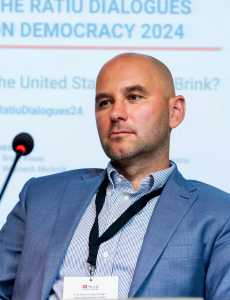 Wojciech Michnik, Ph.D. is currently an assistant professor of International Relations and Security Studies at Jagiellonian University; Transatlantic Project Coordinator for the Central and South-East Europe Programme at the London School of Economics IDEAS at JU; and a contributing editor for the New Eastern Europe. He was a 2023-24 Fulbright-NATO Security Studies Fellow at the University of Arizona. In 2019 dr. Michnik served as the Eisenhower Defense Fellow at NATO Defense College in Rome. Previously he was a a Fulbright visiting scholar at Columbia University’s Harriman Institute in 2015-2016. Dr. Michnik holds a Ph.D. in International Relations from Jagiellonian University. His main research interests include Transatlantic Security and NATO-Russia relations; NATO's Frontline States; and Great Power Competition in the Middle East.
 Samuel Zilincik, Ph.D., is an Assistant Professor at the Royal Danish Defence College. He holds a Ph.D. in Security and Strategic Studies from Masaryk University. His research focuses on military strategy and the psychological aspects of contemporary warfare, including the role of emotions in strategy, decision-making processes, cyber warfare, and deterrence doctrine. He was a visiting fellow at the University of Southern Denmark from 2020 to 2022 and at Leiden University in 2019. He has published extensively, including in the Journal of Strategic Studies, Contemporary Security Policy, Texas National Security Review, RUSI Journal, and Military Strategy Magazine. He has served as an assistant editor for two volumes of the Cambridge History of Strategy.